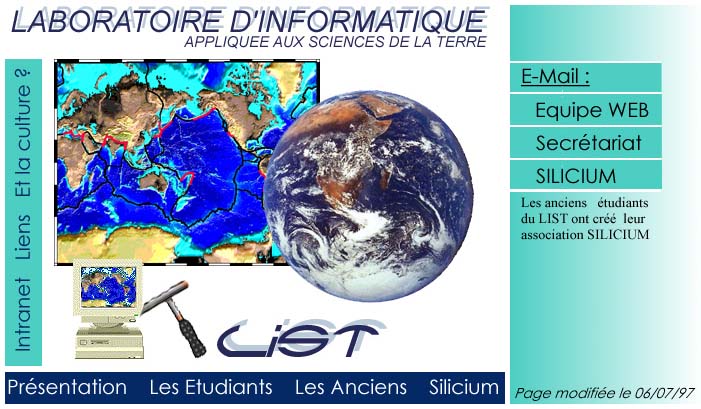
The L.I.S.T.
The Laboratoire d’Informatique des Sciences de la Terre, at Jussieu, where the whole system was taught. It no longer exists.
What it was
The L.I.S.T. was a laboratory of the Université Pierre et Marie Curie, Paris 6, directed by François Bouillé. It no longer exists. The name says what it did: computing in the service of the earth sciences, meaning cartography, geodata banks, surveying and, in the funding language of the 1980s, petroleum exploration. It is the affiliation Bouillé prints on his papers from that decade.
For a student it was something else. It was the place where one system was taught end to end: the HBDS data model, the abstract data types, the language that manipulated them, the storage underneath, the inference on top. Not a survey of the field: one coherent design from one designer, in enough depth to build it. The lectures came with a polycopié, and the 1995 edition is the source of this project: Projet G.L., Énoncé 1995-96, 165 pages, the brief for the year’s software engineering project and a digest of the courses. As an object: A4 sheets printed on both sides, photocopied, in a black plastic comb binding; laser-set text in a sans-serif face, the figures drawn on a computer, a few corrections in ink in the BNF.
The teaching
Two diplomas, both named “Double compétence: informatique appliquée aux sciences de la Terre”, both under Bouillé.
- DU
- Second cycle, two years, for students at bac+3 or bac+4: eight modules of 125 hours a year, a computer-assisted field course, a laboratory placement, an industrial one.
- DESS AIST
- Third cycle, one year, sixty to eighty students a year: knowledge engineering, databases and expert systems, simulation, geomatics and GIS, neural methods, supercomputer architecture, networks, software engineering, petroleum geophysics, offshore robotics.
The year ran on projects: a bibliographic study presented to the whole lab, a CAO-géomatique program in teams of three or four, a Brainware structuring of a real-world case, the software engineering project that is the polycopié, and a final application. The alumni association is called Silicium.
Dates
- 1975-76: Bouillé publishes from the Laboratoire de tectonophysique and the Institut de programmation of the same university. No L.I.S.T. yet.
- 1986: “L.I.S.T., boîte 1000” is the affiliation printed on his Auto-Carto London paper.
- 1997 to 2001: the laboratory’s website, with class lists from 1994-95.
- April 2001: the DESS is up for renewal with the ENSG as partner; the ministry wants the “double compétence” label dropped, and Bouillé writes to the alumni. The website stops being captured after May 2001.
- Later: the DESS becomes the Master 2 IASIG. By 2017 Bouillé’s last Paris 6 theses are attached to another unit, METIS.
What I do not know: the year the laboratory was created, between 1977 and 1986; the year it closed, after 2001; whether the DU outlived the 1990s; who taught there besides Bouillé and the coordinators Hubert-Baton, Chotin and Delay.
My time there
I was at the L.I.S.T. from 1995 to 1998: the DU for two years, then the DESS in 1997-98. They were rather wonderful years, and an enormous amount of work got done. What stays with me most is the whiteboard sessions, a team around a graph, arguing out the best algorithm to find something in it. From 1996 to 1998 I was also the laboratory’s network and IT administrator, and I built its website by hand, www.list.jussieu.fr, the one the Wayback Machine kept. I taught Pascal for a year. Going through the DU and then the DESS, I met four classes in a row and a little of the fifth; the ties with the 1995 class are still strong. That is why the polycopié is still on my shelf.